The split-spoon sampler drives into the ground with a 63.5-kilogram hammer, and that blow count tells us more about Naas soils than any desktop study ever could. We've run countless SPT rigs across the town's industrial estates and residential developments, and the pattern is consistent: stiff glacial till overlying limestone bedrock, but with lenses of softer clay that catch people out. A soil mechanics study here isn't just routine sampling. It's about mapping those lenses before they cause differential settlement under a new warehouse slab or a housing scheme near the canal. The borehole log and the triaxial cell back at the lab work together to give us the full picture. When we pair this with an SPT drilling campaign, we get both the stratigraphy and the strength profile in one go.
Glacial till in Naas looks competent on the JCB bucket, but the lab tells a different story when you measure its undrained shear strength.
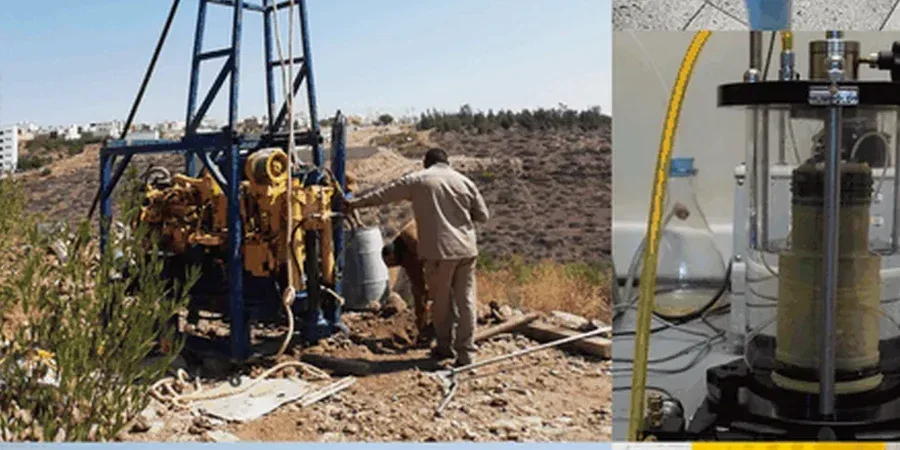
Service characteristics in Naas
Live process video
Risks and considerations in Naas
The most common mistake we see in Naas is assuming the grey boulder clay is uniform. A contractor excavates for a strip footing, sees stiff material in the bucket, and pours the concrete. Six months later, a corner of the building cracks. The problem? A lens of soft, compressible clay sat three metres below the footing, undetected because the trial pit stopped at two metres. We've dealt with exactly this scenario near the Sallins Road, where a test pit programme plus deeper boreholes caught the soft spot before the slab went in. Another risk is excavating in till during winter: the material turns to slurry with heavy rain, and your bearing capacity drops overnight. A proper soil mechanics study includes seasonal moisture effects in the design profile. If you're working near the canal, add peat to your list of worries—it's unpredictable in thickness and highly compressible.
Our services
Our Naas projects typically start with a phased investigation, because spending on targeted lab tests saves multiples of that cost during construction. Here's how we structure the work.
Site Investigation and Lab Programme
Boreholes with SPT sampling, trial pits for shallow profiling, and a lab schedule covering classification, triaxial, oedometer, and chemical tests. We design the grid to capture the till variability across your site, not just the easy-access corners.
Foundation Design Parameters Report
A concise, calculation-ready document giving bearing capacity, settlement estimates, and earth pressure coefficients for your structural engineer. We include the design groundwater level and sulfate class so the specification is complete.
Quick answers
Is a soil mechanics study mandatory for a single house in Naas?
Kildare County Council will almost always condition a site investigation for new builds, especially given the variable glacial soils in the area. The building control regulations require that foundations be designed based on known ground conditions, and a soil mechanics study is the accepted way to demonstrate that. For a single house, a trial pit with lab classification and a bearing capacity statement is often sufficient, but we recommend at least one deeper borehole to check for soft layers.
How much does a soil mechanics study cost for a typical Naas site?
For a standard residential or light commercial site in Naas, including a borehole, trial pits, lab testing, and a factual report with design parameters, costs generally range from €2,440 to €4,520 depending on depth, access, and the number of lab tests required. A more complex industrial site with multiple boreholes and advanced triaxial testing will be at the upper end or beyond.
What lab tests are most important for the boulder clay we have around Naas?
Classification tests — moisture content, Atterberg limits, particle size distribution — tell us the clay fraction and plasticity, which drive behaviour during wet weather. For strength, we run unconsolidated undrained triaxial tests on cohesive samples. If we suspect settlement could govern the design, an oedometer consolidation test is essential. We also test for sulfates and pH because the till can be aggressive to buried concrete.
Can you do the investigation if my site has poor access?
Yes. We use tracked rigs that can navigate tight suburban gardens and narrow side passages in Naas. For sites where a drilling rig truly cannot reach, we deploy hand-dug trial pits and dynamic probing where the ground allows. The investigation strategy adapts to the access constraints without compromising on the quality of the soil mechanics data.
How deep do you typically investigate for a two-storey building in Naas?
We usually aim for a depth of at least 1.5 times the foundation width below the proposed formation level, with a minimum of 3 metres. In Naas, where the till can mask soft layers, we often go to 5 or 6 metres with at least one borehole to confirm the stratigraphy. If rock is encountered, we core at least 3 metres into the limestone to rule out cavities or weathered zones.