The ground conditions north of the canal in Naas, where fluvial silts from the Liffey tributaries dominate, demand a fundamentally different approach than the stiffer glacial tills found toward Sallins Road and the M7 corridor. A standard pad footing that performs adequately on the higher ground east of the town centre will often exceed tolerable settlement limits within the floodplain deposits near the Grand Canal Harbour redevelopment area. Stone column design bridges this gap by creating stiff, draining inclusions that transfer structural loads past the compressible upper strata. We run the design process from our Kildare laboratory, combining CPT profiling to map the soft clay thickness with laboratory grain size analysis on samples retrieved from each target depth, because the silt fraction dictates the drainage radius and the column spacing calculations that follow.
A well-designed stone column transfers 70–90% of the structural load to the competent bearing layer while accelerating primary consolidation drainage by a factor of three to five.
Service characteristics in Naas
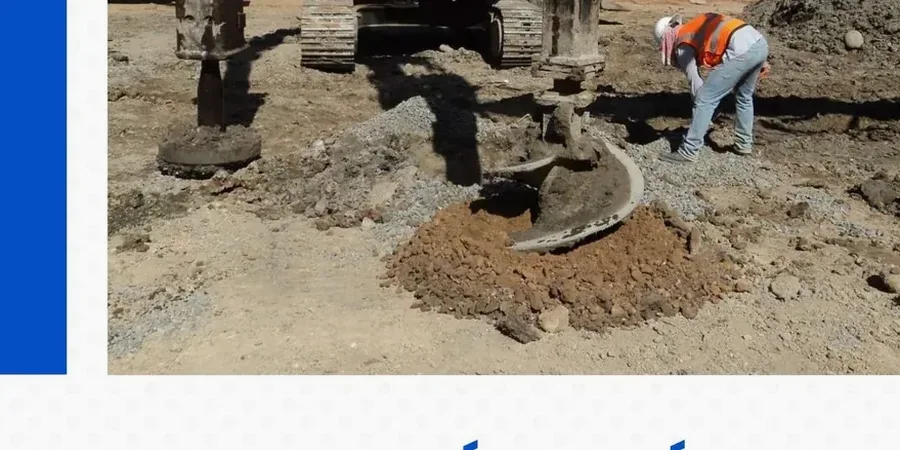
Live process video
Risks and considerations in Naas
A three-storey mixed-use development near the canal basin in Naas started excavation with the assumption that a 200 mm reinforced raft on 2 m of engineered fill would suffice. Within two weeks of breaking ground, the contractor hit a pocket of saturated peat at 3.5 m that had not appeared on the preliminary desktop study. The foundation design was paused, and we were called in to run a targeted CPT investigation across the footprint. The cone resistance dropped below 0.4 MPa across half the site, indicating that even a thickened raft would background post-construction differential settlement exceeding 40 mm over five years. The stone column solution we designed replaced 25% of the soft material with compacted aggregate columns, shortening the drainage path and bringing total settlement estimates back under the 15 mm serviceability limit. The lesson is that pre-construction ground investigation in Naas must extend at least 2 m below the deepest anticipated column toe, because the buried channel deposits of the Morell River tributaries are too erratic to predict from surface mapping alone.
Our services
We deliver the full stone column design package from desktop analysis through to installation verification, adapted to the ground conditions encountered across County Kildare.
Settlement analysis and column layout
Unit cell and finite element modelling to determine the area replacement ratio, column spacing, and depth required to meet the project settlement criteria under static and live loads.
Aggregate specification and quality control
Grading, Los Angeles abrasion, and sulphate soundness testing on the proposed aggregate source to confirm compliance with IS EN 13242 before any material reaches the site.
Post-installation verification
Single-column and composite ground load tests, together with CPT profiling between columns, to confirm that the installed treatment achieves the design modulus and drainage performance.
Quick answers
What ground conditions in Naas warrant stone columns instead of a piled raft?
When the compressible alluvial layer is between 3 and 12 m thick, and the undrained shear strength sits above 15–20 kPa, stone columns become a competitive alternative to piling. Piled rafts are preferred when the soft layer exceeds 15 m or the shear strength drops below 12 kPa, which sometimes occurs in the deeper buried channel deposits south of the canal. The decision turns on a cost–benefit analysis that weighs the drilling depth, the column spacing, and the settlement tolerance of the superstructure.
How do you verify that the installed stone columns are performing as designed?
We run a combination of post-installation CPT soundings through the column centre and at the midpoint between columns, plus zone load tests on groups of three to five columns. The CPT data confirms the compaction density profile, while the load test measures the composite modulus of the treated ground under staged loading. Results are compared against the design settlement reduction factor specified in the unit cell analysis.
What is the typical cost range for a stone column design package in Naas?
A full design package covering site investigation review, settlement analysis, column layout drawings, aggregate specification, and post-installation verification testing typically falls between €1,280 and €4,230, depending on the footprint area and the number of CPT profiles required to characterise the site variability.
Does the high water table near the Grand Canal affect stone column installation?
A high water table actually benefits the wet top-feed vibratory method used across most Naas sites, because the water column inside the casing stabilises the borehole during aggregate placement. The main complication is managing the spoil and water discharge on constrained urban sites, which we address through a site-specific environmental management plan agreed with Kildare County Council before mobilisation.