Naas sits at an elevation of roughly 90 metres above sea level, on the edge of the Curragh plain where gravelly soils meet occasional pockets of softer clay. For any development involving access roads or parking areas, that mix of ground conditions means the subgrade strength can change across a site. We run laboratory CBR tests to give design engineers a reliable number for pavement thickness, because guessing at the soil strength here has a habit of turning into premature rutting. Whether it is a new housing estate off the Monread Road or a commercial yard near the M7 interchange, the CBR value from a properly prepared sample helps avoid overdesigning the pavement or, worse, underdesigning it. We have seen enough Naas projects where a few days of heavy rain revealed just how variable the local ground can be.
A soaked CBR test result changes how much stone you buy—and in Naas, that difference can be worth thousands over a full pavement area.
Service characteristics in Naas
Risks and considerations in Naas
Something you only notice after working on a few Naas jobs is how much the soil can change between the northern side of town, where the ground drains better, and the lower-lying areas south of the canal. We have pulled samples from two boreholes thirty metres apart that gave soaked CBR values of 2% and 8% respectively. If the pavement is designed off a single optimistic number, the weak spot fails first and then the whole surface degrades faster than anyone budgeted for. What makes it trickier is that many sites around Naas were previously agricultural land, so the topsoil strip depth and the quality of the fill placed afterwards have a huge influence on what the laboratory CBR test will show. We always recommend testing the worst material, not the best, because that is what will govern the long-term performance of the pavement.
Our services
We adapt our testing programme to what each Naas project actually needs, from a one-off CBR check to a full suite of pavement design inputs.
Soaked laboratory CBR test
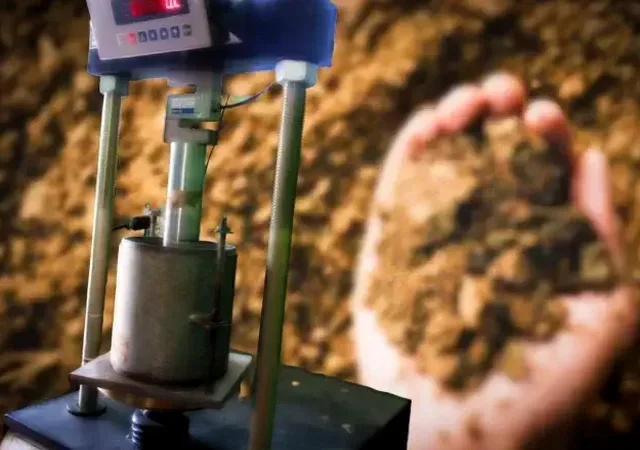
The core test for pavement design, run on a remoulded sample compacted at the target density and moisture content, then soaked for four days under a surcharge matching the expected final pavement weight. We report CBR at both 2.5 mm and 5.0 mm penetration, plus swell percentage.
CBR plus Proctor compaction
We determine the maximum dry density and optimum moisture content of the subgrade material first, then compact the CBR specimen to the specified percentage of that maximum. This gives a CBR value tied directly to the compaction specification the contractor must meet on site.
Soil classification before CBR
Before running the CBR test we often carry out particle size distribution and Atterberg limits on the same sample. Knowing whether the soil is a sandy gravel, a silty clay or something in between helps interpret the CBR result and decide if stabilisation is worth pursuing.
Quick answers
What does a laboratory CBR test in Naas typically cost?
For a single soaked CBR test on a remoulded sample, including sample preparation, compaction and the full four-day soaking period, the cost in Naas usually falls between €120 and €180. If you need the Proctor compaction curve determined first, or additional tests like particle size distribution on the same sample, the total will be slightly higher. We always confirm the price before starting so there are no surprises.
How long does it take to get the CBR result back?
The soaking alone takes four days, and we need time before that for sample preparation and compaction. In practice, you should allow five to seven working days from when we receive the bulk sample to when the final report is ready. If the project is urgent we can sometimes turn it around in five days, but that depends on lab capacity at the time.
Can you test samples taken from site by our own crew?
Yes, that happens quite often around Naas. We supply guidance on how much material to collect and how to bag and label it to avoid moisture loss or contamination. As long as the sample is representative of the formation level and arrives in good condition, we can run the full soaked CBR procedure on it.
What CBR value is considered acceptable for a car park or access road in Ireland?
There is no single magic number because it depends on the traffic loading and the pavement structure, but for a lightly trafficked car park a soaked CBR of 5% or above is often workable without stabilisation. For an access road serving a housing estate or a commercial yard with heavier vehicles, values below 8% to 10% usually trigger a conversation about either deepening the subgrade excavation, improving the material with cement or lime, or increasing the pavement thickness. The real value of the test is that it replaces assumptions with a measured number so the designer can make a proper call. More info.