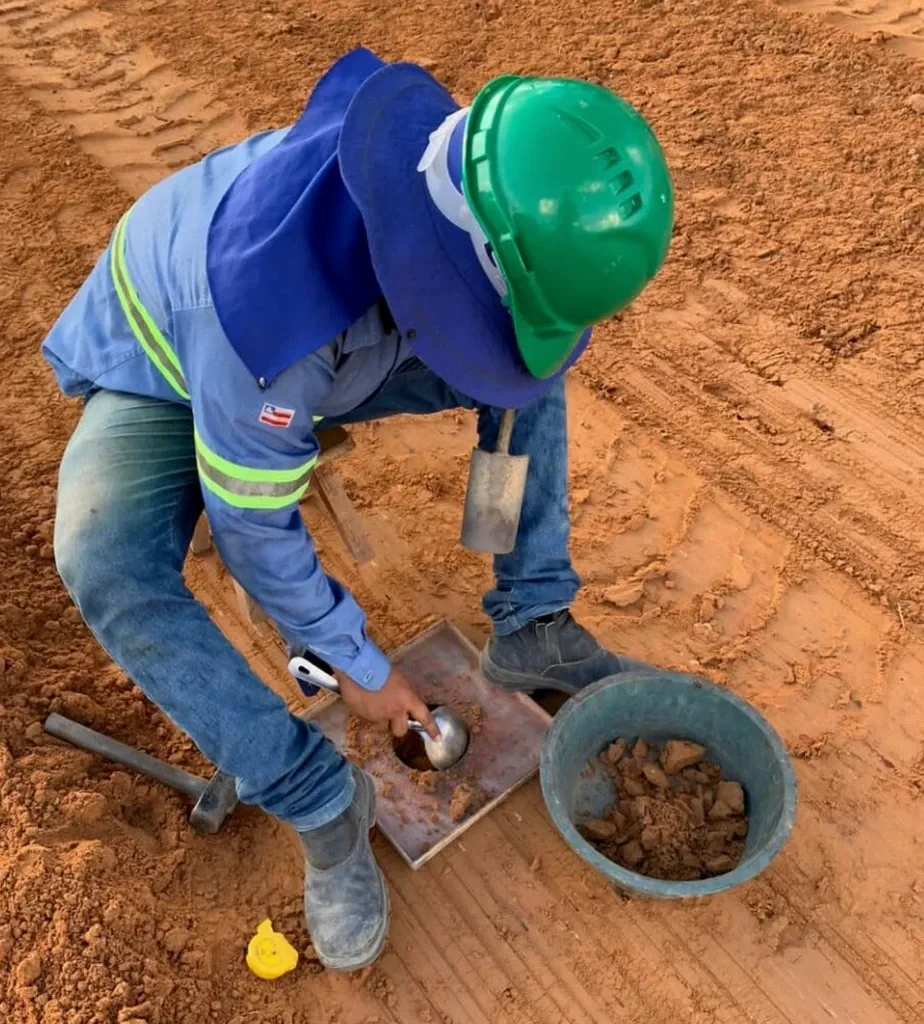
Naas sits at roughly 100 metres above sea level, built on glacial till and gravels that define much of the Kildare lowlands. With the town’s population now exceeding 26,000, new housing estates and link roads push into ground that needs careful compaction verification. In our background, a field density test using the sand cone method remains the most direct on-site check for engineered fill. We see too many sites where a quick pass with a nuclear gauge misses the point—the sand cone gives you a physical measurement, not a proxy. That matters when you’re placing structural fill beneath a foundation slab or a road capping layer. For deeper stratigraphy, we pair the density test with SPT drilling to confirm bearing capacity below the compacted lift. Naas’s variable drift deposits mean you can’t assume uniformity from one end of the site to the other.
A sand cone test gives you a density number you can defend in an NRA audit. It’s a direct measurement of the compacted layer—no correlation factors, no battery issues.
Service characteristics in Naas
Risks and considerations in Naas
The NRA Specification for Road Works Series 600 is the backbone of compaction acceptance in Ireland, and failure to meet the specified relative compaction can trigger a non-conformance report that halts work. In Naas, the risk is compounded by the glacial subsoil—a mix of stiff boulder clay and pockets of water-bearing sand and gravel. If the field density test shows low compaction on a road capping layer, you’re not just re-rolling; you may need to strip the lift and investigate drainage. We’ve seen a single failed test on a roundabout approach delay the opening by three weeks. The sand cone method, done right, catches under-compaction early. The cost of retesting and rework is trivial compared to a pavement failure two years after handover. We document every test with GPS coordinates, weather conditions, and layer thickness so the road authority has a complete record.
Our services
Our field density testing in Naas covers the full chain from laboratory Proctor reference to on-site sand cone measurement. We keep the same calibrated sand and balances across all jobs, so your results are traceable and repeatable.
Sand Cone Density Test (On-Site)
Direct measurement of in-place density on compacted fill, sub-base, and capping layers using the sand replacement method. Results reported immediately on site.
Laboratory Proctor Compaction
Standard and modified Proctor tests to establish the maximum dry density and optimum moisture content reference values for your fill material, tested to BS 1377-4.
Compaction Verification for NRA Compliance
Structured testing programmes aligned with Series 600 requirements, including random sampling plans, documentation for payment milestones, and non-conformance reporting.
Quick answers
What’s the typical cost of a sand cone density test in Naas?
For sites around Naas, a single sand cone test typically runs between €100 and €120, which includes the technician’s time, calibrated sand, and the site report. The price drops per point when we’re doing a full day of testing—most earthworks programmes need 6 to 12 points a day. We’ll give you a fixed day rate based on your test frequency and site location.
How deep does the sand cone test go, and does it work in stony Kildare till?
The test measures the density of one compacted lift, so typically 150 to 300 mm deep. In stony glacial till with particles larger than 37.5 mm, the standard sand cone method becomes less reliable because the excavation hole gets irregular. For those conditions, we switch to a larger replacement method or use a water replacement technique, and we always note the particle size limitation in the report.
How soon after compaction can you run a density test?
We can test immediately after the roller passes, as long as the surface is firm enough to walk on and the sand cone plate can sit flush. There’s no waiting period—unlike nuclear gauge methods, we don’t need a calibration block or a warm-up. That means we can give the contractor a pass/fail result while the roller is still on the lift, which keeps the earthworks cycle moving.