The underlying geology of Naas presents a layered sequence of stiff glacial till overlying Carboniferous limestone, often with a highly variable bedrock surface. Groundwater perched within the till or flowing through fissured rock at depths of less than 6 metres creates a dual challenge for any excavation exceeding 4 metres: controlling base instability and managing lateral earth pressures simultaneously. A solid geotechnical design of deep excavations is not a box-ticking exercise here; it is the primary safeguard against costly delays and wall collapse. Our technical team models the specific strength and stiffness parameters of Kildare till, applying the observational method defined in Eurocode 7 (EN 1997-1:2004) and the relevant Irish National Annex to predict the soil-structure interaction of propped or anchored retaining systems. For sites near the Grand Canal or the M7 interchange, where soft alluvial pockets can appear unexpectedly, we often integrate supplementary data from a CPT test to refine the ground model before finalising the temporary works.
A deep excavation in Naas till fails not from a single design error, but from the accumulation of small misjudgments about groundwater lag and relaxation time. We design to interrupt that chain.
Service characteristics in Naas
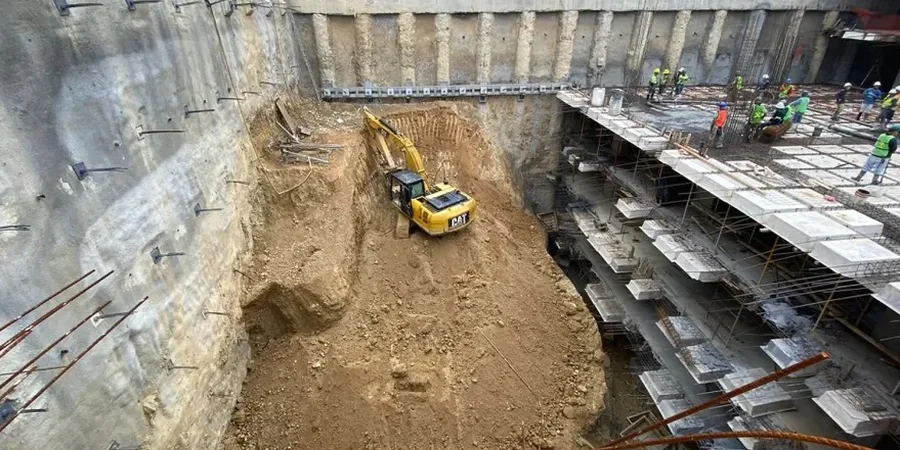
Risks and considerations in Naas
A deep excavation for a six-storey mixed-use development on the Sallins Road encountered a 2-metre-thick layer of water-bearing silt at 7 metres depth that the desk study had missed. The original cantilever sheet pile design became unworkable within hours of pumping; wall deflections exceeded 50 mm and the base of the cut began to soften rapidly. The contractor halted work and our team was brought in to implement an emergency redesign. We switched the support system to a propped contiguous pile wall with an in-situ dewatering array, recalibrating the factor of safety against hydraulic heave using Terzaghi’s method modified for the narrow excavation width. The lesson from that Naas project is clear: a geotechnical design of deep excavations must anticipate the transition from drained to undrained behaviour as excavation rates outpace pore pressure dissipation. Without that anticipation, the temporary works become the permanent problem.
Our services
Our deep excavation design service in Naas covers the full lifecycle of the temporary works, from initial feasibility through to construction support and monitoring review. Each deliverable is calibrated to the specific ground profile and space constraints of the site.
Temporary Works Design for Basements and Shafts
Complete structural and geotechnical design of embedded retaining walls for commercial, residential, and infrastructure excavations in Naas. The package includes prop layout and sequencing, waler beam sizing, base slab reaction analysis, and a detailed deflection monitoring plan with trigger levels. We produce design certificates and construction-stage submittals compliant with the Safety, Health and Welfare at Work (Construction) Regulations.
Peer Review and Construction Support
Independent check of contractor-designed temporary works for deep excavations, verifying the ground model assumptions, wall embedment depth, and global stability against basal heave and overall slip. We attend progress meetings on site in Naas, review inclinometer and piezometer data against the predicted envelope, and authorise contingency measures when monitoring reveals divergence from the Class A prediction.
Quick answers
What is the typical cost range for a geotechnical design of a deep excavation in Naas?
For a single-level basement or a shaft excavation in the Naas area, the geotechnical design fee typically falls between €1,950 for a straightforward propped wall concept and €6,710 for a complex staged excavation requiring 3D finite element analysis with groundwater coupling. The final figure depends on the retained height, the number of construction stages, and whether a peer review is required by the client or the local authority.
How do you model the stiff glacial till found in Naas for a deep excavation design?
We use the Hardening Soil with small-strain stiffness (HSsmall) constitutive model in Plaxis, which captures the high initial stiffness at very small strains and the non-linear stiffness degradation with increasing shear strain. Parameters are calibrated from advanced triaxial tests with local strain measurement, and the small-strain shear modulus G0 is verified using in-situ MASW data to ensure the wall deflection prediction is not unconservatively soft.
What retaining wall types are most suitable for deep excavations in Naas?
The choice depends on the depth, groundwater conditions, and the proximity to adjacent structures. For cuts up to 6 metres in open sites, a cantilever sheet pile wall with dewatering may suffice. For deeper basements in the town centre, secant pile walls or diaphragm walls are preferred because they can be installed with minimal vibration and can cut through the hard limestone layers encountered below 10 metres depth without excessive refusal rates.
How long does the design process take for a deep excavation in Naas?
A concept design with a ground model report and preliminary wall sizing usually takes 2 to 3 weeks from receipt of a compliant ground investigation report. Detailed design with full calculation packages for submission to the certifier or local authority typically requires an additional 3 to 4 weeks. If the design must be peer-reviewed, allow one extra week for the independent check cycle.