Naas sits at an elevation of roughly 95 metres on the western flank of the Wicklow Mountains, where the underlying geology shifts from limestone-rich tills to pockets of soft alluvium along the Grand Canal and the Liffey tributaries. With the population now exceeding 26,000 and ongoing development around the M7 corridor, the demand for retaining walls and deep basements has grown sharply. A slope stability assessment becomes essential when cut faces intersect weathered glacial deposits, and in many Naas projects we integrate this with a detailed retaining wall evaluation to verify that the proposed anchor system can handle both the short-term construction loads and the long-term service conditions. Active anchors pre-load the ground to control deformation from day one, while passive anchors mobilise resistance as the soil begins to move. Our laboratory team in Naas selects the appropriate type based on site-specific borehole data and the stiffness requirements of the retained structure.
In Naas we routinely encounter glacial till profiles that look competent at the surface but hide soft silt lenses at depth — anchor bond length is where the real margin of safety lives.
Service characteristics in Naas
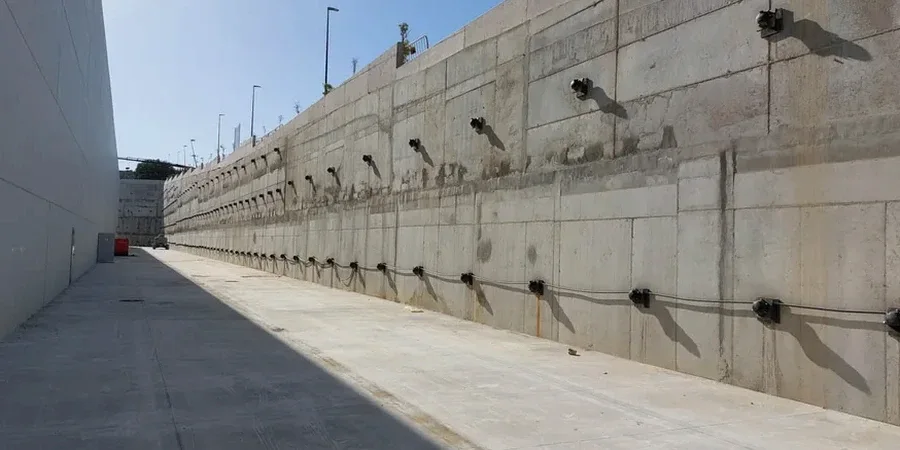
Risks and considerations in Naas
One pattern we observe frequently in Naas is the presence of groundwater perched within the upper weathered till, which can go unnoticed if the borehole investigation relies solely on standpipe readings taken days after drilling. When an anchor is installed through this zone, hydrostatic pressure can build behind the wall if drainage measures are inadequate, effectively doubling the load on the anchor head. Passive anchors are particularly sensitive to this because they rely on a small amount of wall movement to activate; water pressure reduces the effective stress and delays that mobilisation. We mitigate this risk by specifying weep holes or strip drains behind the wall facing and by verifying the water table through piezometer monitoring during the anchor installation phase. A proper excavation monitoring plan provides the early-warning data needed to confirm that the anchor system is performing as predicted.
Our services
Our anchor design work in Naas covers the full sequence from feasibility to acceptance testing. The two core solutions are:
Active anchor design and proof testing specification
We prepare detailed anchor schedules with tendon free length, bond length, lock-off load, and testing acceptance criteria. Each design references the ground model developed from boreholes and CPT soundings executed in the Naas area.
Passive anchor and soil nail design
For temporary excavations or slope reinforcement where movement can be tolerated, we design passive anchors and soil nails that mobilise resistance gradually. The design includes facing details, drainage provisions, and staged construction sequences.
Quick answers
What is the difference between active and passive anchors?
Active anchors are pre-stressed to a specified lock-off load immediately after installation, which controls ground movement from the start. Passive anchors are not tensioned initially; they develop resistance only as the soil mass deforms and transfers load into the tendon. In Naas we select the type based on the allowable deflection of the adjacent structures and the stiffness of the ground.
How much does an anchor design cost for a project in Naas?
The design fee for a retaining wall anchor system in Naas typically ranges from €960 for a straightforward layout with a few anchors to around €3,830 for a complex scheme requiring multiple anchor rows, corrosion protection detailing, and staged testing specifications. A firm quotation is provided after reviewing the site investigation data.
What testing is required for ground anchors in Ireland?
I.S. EN 1537:2013 requires three test types: investigation tests on sacrificial anchors to confirm the design bond length, suitability tests on working anchors to validate installation methods, and acceptance tests on every anchor to verify the load-displacement behaviour. Our team specifies the test loads and acceptance criteria for each anchor row.
Can anchors be installed in the glacial till found under Naas?
Yes, but the presence of cobbles and boulders in the till demands careful drilling technique. Rotary percussive duplex drilling is often necessary to maintain borehole stability and to achieve the required bond length without collapsing the hole. We log the drill returns during installation to confirm that the grouted zone aligns with the ground model.