Crossing from the limestone ridge near Naas Racecourse down to the alluvial flats along the Grand Canal, ground conditions shift sharply within a few hundred metres. We have pulled split-spoon samples from dense boulder clay at the Lakeside development and, the same week, logged soft silty sand at a site off the Sallins Road. That contrast matters for foundation design. The Standard Penetration Test (SPT) remains the most widely specified in-situ index in Irish practice, giving you a direct N-value that feeds straight into bearing capacity estimates, settlement checks, and liquefaction screening under IS EN 1998-5. In Naas, where glacial till overlies limestone bedrock at highly variable depth, skipping SPT boreholes leaves your ground model blind.
In Naas, refusal N-values beyond 50 often signal the top of weathered limestone — a contact that controls both excavation method and pile toe level.
Service characteristics in Naas
Risks and considerations in Naas
Naas expanded rapidly through the Celtic Tiger years, with housing estates spreading onto farmland underlain by the legacy of glacial Lake Blessington. Much of the town centre sits on made ground, while the outer ring roads cut across esker gravels and compressible lacustrine clays. Undetected soft lenses at 2 to 5 metres depth have caused differential settlement claims in several local developments. The SPT provides a repeatable, low-cost profile that flags these weak horizons before shovels go in. Relying solely on trial pits misses the deeper stratigraphy; a borehole with SPT every metre, combined with laboratory classification of the recovered sample, gives the full picture required by IS EN 1997-2.
Our services
Every SPT borehole we drill in Naas feeds into a broader investigation package. The rig, the sampler, and the lab operate as one chain so the N-value, the core log, and the Atterberg result tell a single story.
SPT drilling with calibrated hammer
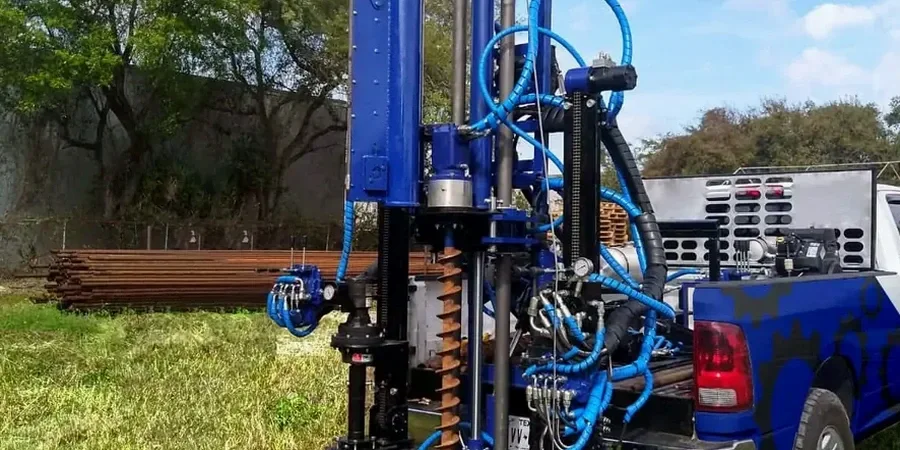
Track-mounted or low-access rigs with automatic trip hammer. N60 values reported, with split-spoon samples bagged for immediate laboratory classification back at our Kildare facility.
Undisturbed sampling and lab testing
Where SPT logs show sensitive fine-grained soils, we follow up with Shelby tubes and run triaxial, oedometer, and Atterberg limits to complete the ground model for settlement-sensitive structures.
Correlation profiling with CPT
For sites with complex interbedded stratigraphy, we run complementary CPT soundings on the same grid, using SPT-CPT correlations to refine soil behaviour type and detect thin drainage layers.
Quick answers
What does the SPT actually measure, and why does it matter in Naas?
The SPT measures the blow count (N-value) required to drive a standard split-spoon sampler 300 mm into the soil. In Naas, where glacial till, esker gravel, and lacustrine clay can alternate within a single borehole, the N-value gives a direct indication of relative density in sands and consistency in clays. Engineers use it to estimate bearing capacity, friction angle, and undrained shear strength, and to screen for liquefaction susceptibility under the IS EN 1998-5 provisions.
How much does an SPT borehole cost in the Naas area?
A single SPT borehole to 10 metres depth in Naas typically ranges from €440 to €700, depending on access conditions, number of test intervals, and whether undisturbed sampling or laboratory testing is added. Sites requiring traffic management along the M7 corridor or canal-side access fall toward the upper end.
How deep do you usually drill for an SPT investigation in Naas?
Most residential and light commercial projects in Naas require boreholes between 6 and 15 metres. We target at least 3 metres into competent ground — typically the lodgement till or bedrock — to satisfy the requirements of IS EN 1997-2 for the ground investigation depth. For taller structures near the town centre, 20-metre boreholes are common.
Can you perform SPT testing in limited-access locations between existing buildings?
Yes. We operate compact track-mounted rigs that can pass through a standard doorway and drill from a 2.2-metre-wide footprint. These units still deliver the full 63.5 kg hammer energy, so the N-values are directly comparable with those from a full-size rig — critical when extending an investigation beneath an existing structure in Naas town centre.
How quickly do we receive the SPT logs and report?
Field logs with preliminary N-values are issued within 48 hours of completing the boreholes. The final report, including N60 energy-corrected values, laboratory classification results, and geotechnical recommendations, is typically delivered within five to seven working days. For fast-track projects, we can supply a digital borehole log the same day as drilling.