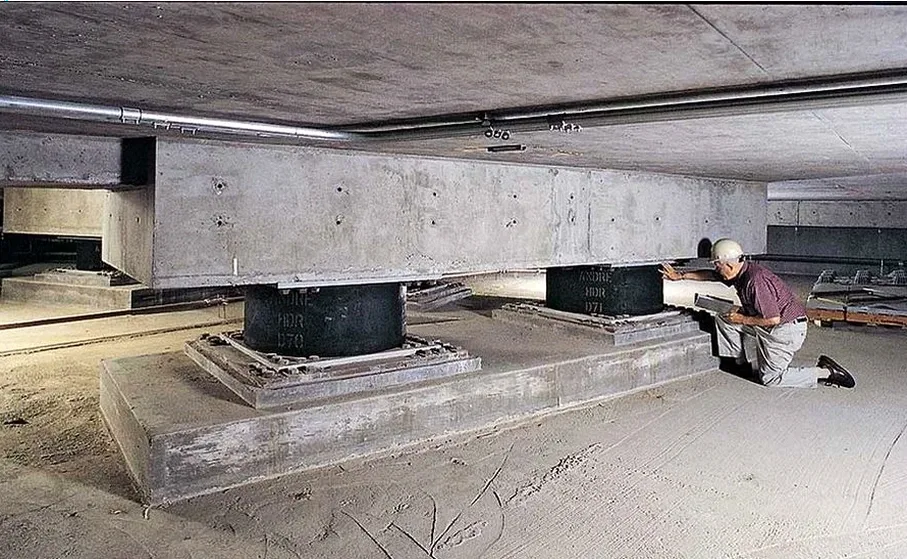
Under Eurocode 8 (EN 1998-1:2004), Ireland is classed as a low seismicity region, but that classification can mislead. The National Annex for Ireland, I.S. EN 1998-1:2005, requires explicit consideration of seismic action for structures in consequence classes CC2 and CC3. In Naas, where recent low-to-mid-rise apartment blocks and office parks are replacing single-storey retail along the Monread Road, the structural brief often shifts toward higher performance levels. Base isolation provides a way to meet operational continuity targets without over-engineering the superstructure. The design process starts with site-specific hazard assessment, factoring in the relatively stiff glacial till that underlies much of Naas town centre. We work directly with structural engineers to define the isolation plane, select elastomeric or sliding isolators, and verify that inter-storey drift stays within the 0.5% limit under the design basis earthquake. In Kildare projects we often combine early-stage dynamic analysis with a seismic microzonation study to refine the bedrock-to-surface amplification model, especially where deep tills show variable shear-wave velocity profiles.
In a low-seismicity region like Ireland, base isolation is not about collapse prevention—it is about keeping a hospital wing or data centre fully operational the day after an event.
Service characteristics in Naas
Risks and considerations in Naas
A four-storey residential block under construction near the canal in Naas in 2017 had its isolation design rejected at tender stage because the isolator displacement was calculated using a generic rock spectrum without site amplification. The till-to-bedrock impedance contrast at 6 m depth produced a factor-of-two increase in spectral acceleration at 0.2 s period, which shifted the effective isolation period and pushed displacement beyond the moat width originally specified. The redesign required a switch from low-damping rubber bearings to lead-rubber bearings with higher characteristic strength and re-analysis of the moat retaining wall for impact loads. The lesson: in Naas, do not skip the site-response step. The bedrock is shallow, the till is stiff, and the amplification is moderate, but it is not zero. A design that relies on rock spectra alone will mis-size the isolators, misjudge the required moat clearance, and risk pounding against retaining walls under the maximum event. We also recommend a liquefaction screening when the building footprint extends onto alluvial pockets near the canal, where loose silty sands occasionally appear in borehole logs.
Our services
The base isolation design service covers the full path from hazard definition to construction-phase testing. Each package is tailored to the building typology and consequence class, with chartered engineer sign-off included as standard.
Site-specific seismic hazard assessment
Probabilistic hazard analysis for the Naas site, incorporating local soil amplification from MASW or crosshole shear-wave velocity profiles. Defines the elastic response spectrum for the design basis and maximum considered earthquake levels used in isolator selection.
Isolation system design and nonlinear analysis
Selection and modelling of elastomeric or sliding isolators, nonlinear time-history analysis with spectrum-compatible accelerogram suites, and verification of inter-storey drift, floor spectra, and moat displacement. Full EN 15129 compliance documentation.
Prototype testing specification and construction oversight
Drafting of testing protocols per EN 15129 Annex A or C, review of manufacturer test reports, and on-site supervision of isolator installation, including bearing alignment checks and moat wall construction verification.
Quick answers
What does seismic base isolation design cost for a project in Naas?
For a building in the Naas/Kildare area, the full design package—including site-specific hazard assessment, isolator selection, nonlinear time-history analysis, and EN 15129-compliant documentation—ranges from €3,440 to €7,280. The final figure depends on the number of isolators, the complexity of the superstructure, and whether a peer review is required for consequence class CC3 structures. Prototype testing specification and construction-phase oversight are priced separately based on the testing programme scope.
Is base isolation necessary for buildings in a low-seismicity country like Ireland?
Necessity is defined by the project brief and consequence class. For ordinary residential buildings, fixed-base design with ductility class DCM is usually sufficient. For hospitals, data centres, or high-value industrial facilities where operational continuity after a seismic event is non-negotiable, base isolation is the most reliable way to limit floor accelerations and protect sensitive equipment. The Irish National Annex to Eurocode 8 still requires seismic checks for CC2 and CC3 structures, and isolation can simplify those checks by reducing inelastic demands on the superstructure.
How do you verify that the isolators will perform as designed?
Verification follows EN 15129:2018, which mandates full-scale prototype testing of at least two isolators per type. Tests include the full sequence of ageing, loading, and cycling to confirm effective stiffness, damping, and displacement capacity. Production tests are performed on every isolator manufactured. We specify the test protocol, review the laboratory reports, and confirm that measured properties fall within the acceptance ranges used in the structural analysis.
What soil conditions in Naas affect the isolation design?
The lodgement till across Naas is dense and preconsolidated, with shear-wave velocities typically in the 300–500 m/s range. The key issue is the impedance contrast at the till-bedrock interface, which can amplify short-period motion and shift the effective isolation period. We run site-response analysis using measured Vs profiles to capture that amplification. Where the building footprint extends toward canal-side alluvial deposits, we also screen for loose silty sands that could introduce differential settlement beneath the foundation mat.