IS EN 17892-8 and Eurocode 7 require reliable effective stress parameters for any design involving cohesive or transitional soils in Ireland. In Naas the geology is dominated by glacial till — a mix of silty clay with sand and gravel lenses deposited during the last glaciation of the Wicklow Gap. This material can exhibit significant overconsolidation and a tendency to soften upon excavation, which makes drained shear strength the controlling factor for cut slopes and retaining structures. Our triaxial test programme captures c' and φ' under controlled drainage conditions, providing the input needed for PLAXIS or Wallap models. For projects near the Naas Enterprise Park or along the M7 corridor, we often pair the triaxial test with CPT testing to zone the site before sampling, ensuring that specimens are taken from the critical horizons.
Drained strength can be half the undrained value in Naas till — designing on undrained parameters alone risks overestimating long-term stability.
Service characteristics in Naas
Risks and considerations in Naas
A mistake we see repeatedly in Naas is designers ordering UU triaxial tests for projects where the critical condition is long-term drained loading, then applying a blanket factor of safety on undrained parameters. The till at Naas is fissured and can open up during excavation, allowing pore pressure dissipation over weeks — well within the construction programme. Running only undrained tests masks the true drained friction angle, which can be as low as 22° in the weathered zone. We had a case near the canal where a temporary excavation stood at 4 metres vertical without support, but the designer had used UU φ = 28° and had to revise the entire retaining wall specification after drained testing. The correct approach is a staged programme: CU testing with pore pressure measurement to define the critical state line, then CD testing if the project involves permanent cuts or basement retention. For deep foundations in the till we also recommend a pile design analysis that integrates the effective stress parameters from triaxial testing with in-situ CPT data.
Our services
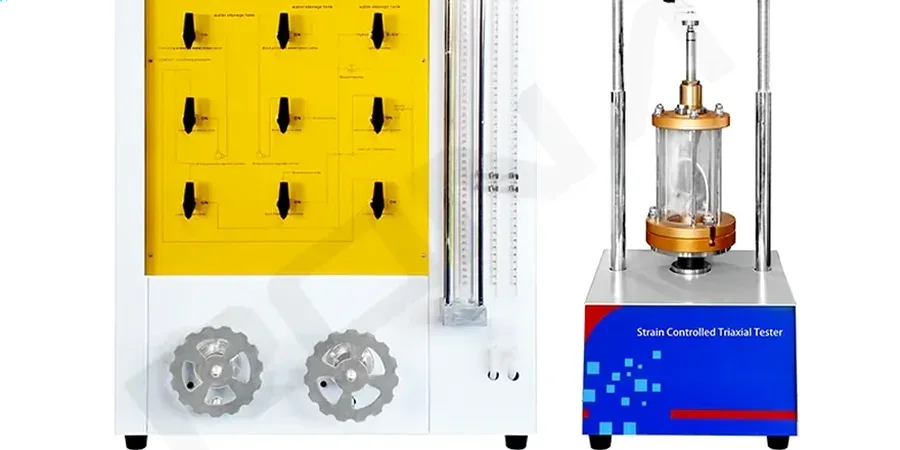
Our triaxial testing in Naas covers the full range of effective and total stress conditions required for geotechnical design on glacial deposits. We work from a UKAS-accredited laboratory with temperature-controlled triaxial cells and automated data acquisition. Each programme is designed around the specific stress history of the site.
Effective Stress Triaxial (CU & CD)
Consolidated-undrained and drained triaxial testing for determining c' and φ' in Naas glacial till. We apply back-pressure saturation with B-value verification, isotropic consolidation to in-situ stress levels, and shearing at rates calibrated to pore pressure dissipation. The complete stress path is plotted on q-p' diagrams and the Mohr-Coulomb envelope is reported with linear regression statistics. Suitable for cut slope analysis, basement retention, and embankment stability in overconsolidated soils.
Total Stress Triaxial (UU)
Unconsolidated-undrained triaxial testing for short-term bearing capacity checks and temporary works design in saturated fine-grained soils. Specimens are sheared at 1-2% strain per minute without consolidation, providing undrained shear strength cᵤ. This test is appropriate for the clay-rich till layers found at depths of 2-5 metres in Naas, where construction loading occurs faster than pore pressure can dissipate.
Quick answers
What does a triaxial test cost in Naas?
A complete triaxial programme in Naas typically ranges from €1.890 to €2.410 for a set of three specimens at different confining pressures. This includes sample extrusion, specimen trimming, saturation, consolidation, shearing, and a full interpretive report with stress paths and Mohr-Coulomb parameters. The final cost depends on whether you need CU, CD, or UU testing and the specimen diameter.
How long does triaxial testing take for a Naas site investigation?
Turnaround depends on the test type. UU triaxial tests can be completed in 3-5 working days. CU and CD tests require longer — typically 10-15 working days — because the consolidation and shearing stages must run at slow rates to allow pore pressure equalisation in the low-permeability till found around Naas.
Which triaxial test type is correct for glacial till in Naas?
For permanent works on Naas glacial till we recommend CU triaxial testing with pore pressure measurement as a minimum. This gives you effective stress parameters c' and φ' for drained design, plus undrained shear strength for short-term checks. CD testing adds further confidence for critical slopes or deep basements where long-term drained behaviour governs stability.