Designing a retaining wall in Naas isn’t just about holding back soil. The real challenge starts with I.S. EN 1997-1:2005, the Irish National Annex to Eurocode 7, which demands a rigorous geotechnical investigation before any structural calculation begins. Naas sits on the edge of the Wicklow foothills, where the subsoil shifts from stiff Dublin glacial till to pockets of soft alluvial clay along the Grand Canal branch. We’ve seen projects where a wall was perfectly designed on paper, but the ground model missed a two-metre layer of organic silt near the canal towpath—and that changes everything. Getting the ground investigation right early on, especially around the canal corridor where water tables stay high year-round, determines whether your design actually performs over the next thirty years. The town’s rapid expansion along the Monread Road and towards Sallins has pushed more development onto these marginal soils, making a proper site-specific retaining wall design essential rather than optional. Our approach integrates in-situ testing with laboratory verification, so the wall geometry and reinforcement aren’t just code-compliant—they’re grounded in what’s actually beneath the site in Naas.
A retaining wall design is only as reliable as the ground model behind it—and in Naas, the glacial till doesn’t read the textbook.
Service characteristics in Naas
Risks and considerations in Naas
The investigation rig we mobilise to Naas isn’t a light cable tool—it’s a tracked rotary and CPT unit that can push through the stony upper till without refusal. That matters because we need continuous data through the weathered zone where most failure planes initiate. A cantilever wall built on the Sallins Road in 2018 rotated forward after a wet November because the investigation stopped at three metres, missing a soft silt lens at four metres that acted as a slip surface. We use the CPT to map the stratigraphy in real time, and when we encounter the dense till at depth, we switch to sampling with thin-walled tubes for laboratory strength testing. The main risk in Naas isn’t the overall bearing capacity—the till is competent—it’s the undetected soft inclusions and the seasonal groundwater perched within fissures. Without a design that explicitly models these local conditions, you’re exposing the wall to serviceability issues: tilting, cracking, and drainage failure that are expensive to remediate once the landscape is finished.
Our services
A retaining wall design in Naas draws on several interconnected geotechnical solutions. We don’t treat design as an isolated drafting exercise—it’s the final step after a thorough ground characterisation. Below are the core solutions that feed into a reliable wall design for Irish soil conditions.
Site Investigation and Soil Parameter Definition
Before drawing a single reinforcement detail, we drill boreholes, push CPT soundings, and excavate test pits to build a three-dimensional ground model of your Naas site. We extract undisturbed samples for triaxial compression testing, define the drained and undrained strength envelopes, and measure groundwater levels over at least one seasonal cycle where possible. This data feeds directly into the geotechnical design report that underpins the wall calculations.
Structural and Geotechnical Wall Design Package
We deliver a complete Eurocode 7 design package: external stability checks (sliding, overturning, bearing), internal structural design of the stem and base per Eurocode 2, and drainage detailing. For reinforced soil walls, we specify the geogrid length, strength, and vertical spacing. Every calculation references the site-specific soil parameters, not generic assumptions, and we supply construction-phase monitoring recommendations to verify the design assumptions during excavation.
Quick answers
How much does a retaining wall design cost for a typical residential project in Naas?
For a residential retaining wall in Naas—typically between 1.5 m and 3 m in height—the design package usually falls between €950 and €4,130, depending on the complexity of the ground conditions and whether new site investigation data is required. A small garden wall on competent till with existing borehole logs sits at the lower end; a taller wall near the canal corridor, where we need to commission a CPT and laboratory testing to characterise soft alluvium, moves toward the upper end. Every quote is project-specific and reflects the actual investigation and calculation effort.
What is the difference between a gravity wall and a cantilever retaining wall design?
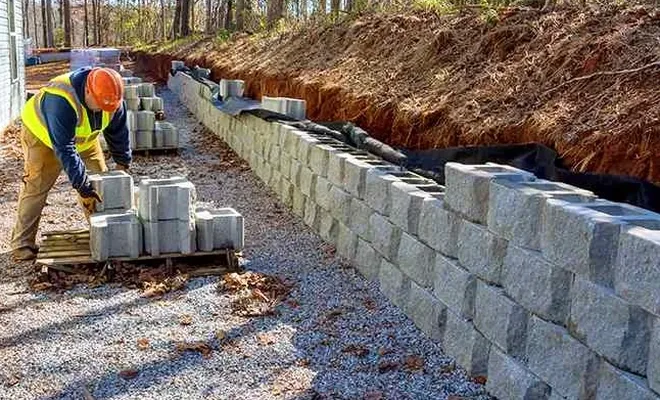
A gravity wall relies on its own mass to resist lateral earth pressure—think gabion baskets, mass concrete, or stone masonry. They’re economical up to about 3 m in Naas, provided you have a wide enough base. A cantilever wall uses a reinforced concrete stem and base slab, with the backfill weight on the heel helping to stabilise the structure. Cantilever walls become more efficient above 3 m, and they’re the typical choice for basement retaining in the new housing developments around Monread. The ground investigation requirements are similar, but the structural design and reinforcement detailing differ significantly.
Do I need planning permission for a retaining wall in County Kildare?
In most cases, yes—retaining walls in County Kildare generally require planning permission if they exceed 1 m in height and are located near a public road or boundary, or if they materially alter the ground levels. Walls over 2 m nearly always trigger a planning application. The planning authority will expect a geotechnical design statement prepared by a competent engineer, which is why we supply a Eurocode 7-compliant report that can be submitted as part of your planning package. We recommend checking with Kildare County Council’s planning department for the specifics of your site.
How long does the retaining wall design process take from start to finish?
A straightforward design on a well-characterised site in Naas can be completed in two to three weeks. That includes reviewing existing ground data, running the stability calculations, and producing the design report with reinforcement drawings. If new site investigation is needed—drilling, sampling, lab testing—add three to four weeks for the fieldwork and triaxial test results. Projects adjacent to the canal or involving deep excavations usually fall into the longer timeline because we need to capture the groundwater regime properly.