The ground beneath Naas tells two very different stories. North of the canal, glacial tills and limestone bedrock supply a reasonably competent base, while the southern approaches toward the Grand Canal and the River Liffey tributaries reveal deep sequences of loose alluvial sands and recent made ground. A standard footing on the south side without ground improvement can settle unevenly within months, simply because the granular skeleton never reached a dense state. The solution lies in a controlled deep vibratory process that re-arranges grains into a tighter, load-bearing matrix. We design vibrocompaction programmes specifically for these Naas site conditions, where a one-size-fits-all grid copied from a Dublin spec will miss the local depth-to-competent-layer and the perched water table that sits barely two metres down in parts of Monread and Jigginstown.
A well-designed vibrocompaction grid in Naas fluvio-glacial sands can raise relative density from 40 to over 75 percent in two passes, eliminating the need for deep foundations.
Service characteristics in Naas
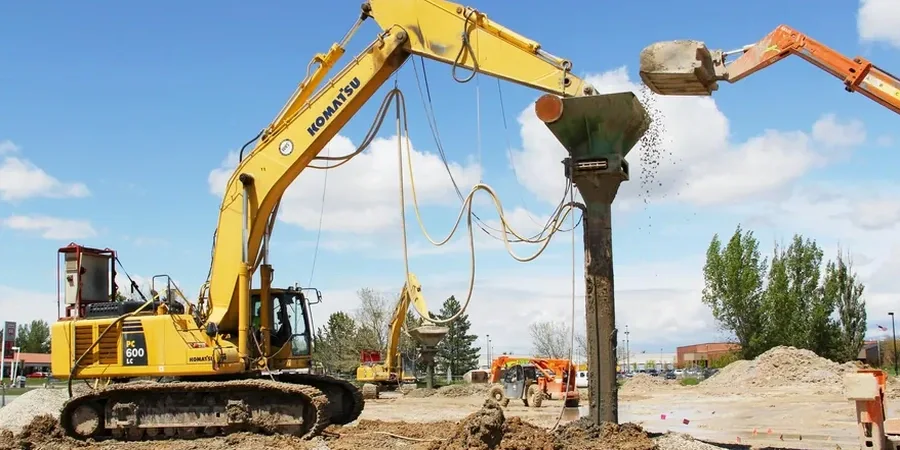
Live process video
Risks and considerations in Naas
The most frequent mistake we see in Naas occurs when a contractor orders vibroflotation rigs with a fixed frequency schedule copied from a previous job in Dublin Port or Ringsend, without accounting for the higher silt fraction in Naas fluvio-glacial deposits. The result is a false set: the probe sinks and the ammeter records a drop, but the surrounding ground barely densifies because the pore pressure builds and the silt films prevent grain rearrangement. The site then passes a superficial plate load test, but six months later differential settlement appears under the slab or the warehouse floor. A proper design sequence avoids this by running dissipation tests during the trial panel and adjusting the pause-and-surge cycle to match the local permeability. When the design is tailored to Naas ground, the improvement is measurable, repeatable, and verifiable with pre- and post-treatment CPT pairs.
Our services
Our vibrocompaction design package for Naas sites covers everything from initial feasibility assessment through to post-treatment verification. Each deliverable is built around the specific granular deposit encountered, not a generic template.
Vibrocompaction Trial Design & Specification
We produce a site-specific trial panel plan that defines probe spacing, vibration frequency, hold depth, and acceptance criteria. The specification includes pre- and post-treatment CPT locations, lab testing requirements for fines content, and a target Dr profile tied to the foundation load and serviceability limit state.
Production Monitoring & Verification
During production compaction we supervise the real-time data acquisition from the rig — depth, amperage, vibration time — and correlate it against the calibrated trial parameters. Verification relies on paired CPT soundings and, where specified, zone load tests mapped against the approved settlement criteria.
Quick answers
What does a vibrocompaction design package cost for a typical Naas site?
For a standard commercial or industrial site in Naas, design fees typically range from €1,530 for a single trial panel specification on a small footprint to €5,250 for a full design-and-verification package covering a larger area with multiple CPT pairs and a production monitoring report. The final figure depends on the treatment depth, the number of trial cells, and the laboratory testing scope required to characterise fines content.
How deep can vibrocompaction treat the loose sands we find around Naas?
With electric vibrators in the 130–200 kW range, we routinely design treatments to 15–20 metres below ground level, and can reach 25 metres where the deposit requires it. The limiting factor is usually not the equipment but the presence of cohesive layers or the groundwater table, both of which we map during the site investigation phase before finalising the treatment grid.
How do you verify that the ground has actually improved after compaction?
We use pre- and post-treatment cone penetration tests at identical locations, comparing cone resistance and sleeve friction profiles before and after the vibro passes. The acceptance criterion is typically a minimum relative density of 70 percent, correlated from the CPT data. In some cases we also run zone load tests or SPT correlations, depending on the foundation type and the structural engineer's requirements.
Can vibrocompaction work on the made ground common in Naas industrial estates?
It depends entirely on the fines content and the uniformity of the fill. Made ground in Naas often contains pockets of silt, clay, or demolition rubble. We take rotary cores and run grain size analyses first. If the fines content stays below about 15 percent and the fill is predominantly granular, vibrocompaction can be very effective. Above that threshold we may recommend stone columns or a hybrid approach.