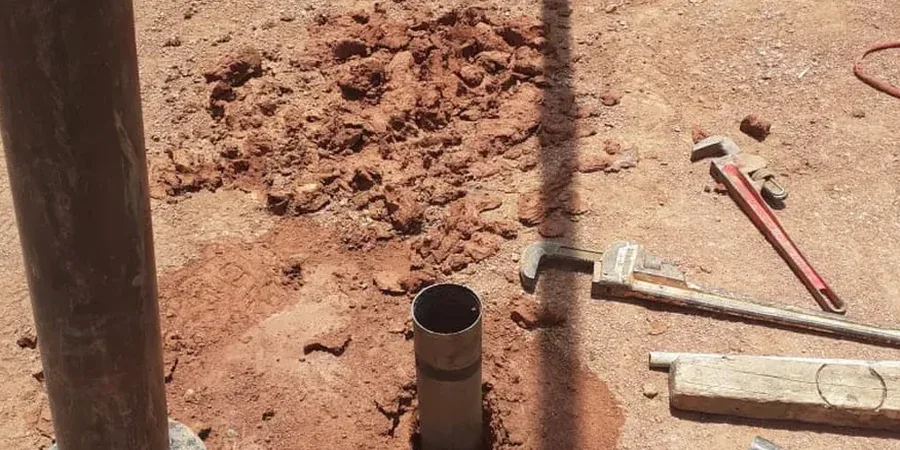
The steel tip of the Lugeon packer slides down the borehole with a familiar metallic scrape, sealing off a test section somewhere in the limestone bedrock beneath Naas. Above ground, a constant-head panel hums steadily while the technician logs flow rates against pressure steps—raw data that will define a basement’s waterproofing strategy or confirm a soakaway’s viability. In the field, the Lefranc method handles the overburden: a short screened interval in the borehole or a driven casing, a steady water supply, and careful measurement of how quickly the surrounding ground accepts flow. Both tests answer the same practical question—how permeable is this ground, right here, right now—but each targets a different material. Across Naas, where the Kildare lowlands shift from dense boulder clay to fractured Waulsortian limestone within a few hundred metres, getting that answer wrong isn’t an option. Our accredited laboratory runs both test types to I.S. EN ISO 22282 standards, with equipment calibrated before every campaign and results interpreted by engineers who understand the local drift geology.
A single Lugeon test in fractured limestone can reveal more about drainage risk than a dozen lab permeability tests on intact core.
Service characteristics in Naas
Live process video
Risks and considerations in Naas
Naas sits on a geological patchwork that catches out more than one groundwork contractor. The southern edge of the town rests on impure limestones of the Waulsortian complex, widely fractured and often riddled with solution features that can swallow a soakaway’s design capacity in minutes. Move north toward the Grand Canal and the profile shifts to stiff lodgement till—dense, silty, and deceptively tight until a sand lens or a buried gravel channel turns up exactly where the percolation area was supposed to go. In one recent case near Jigginstown, a housing scheme’s drainage design assumed a generic coefficient of permeability from a desk study. The actual Lugeon values in the upper bedrock ranged from 12 to 45 Lugeon units across just four test intervals, forcing a complete redesign of the stormwater system. When the water table rises in winter and the till saturates, poorly characterised ground becomes a liability that shows up as flooded gardens, buoyancy pressure on retaining walls, or a surface water management system that simply doesn’t work. A full slope stability assessment often ties directly to permeability data, especially where road cuttings intersect limestone benches that channel groundwater along bedding planes.
Our services
Field permeability testing in Naas covers a range of investigation scenarios. The three service packages below address the most common project demands, from single-house soakaway design to multi-borehole campaigns for commercial developments.
Lefranc Variable-Head Test for Soakaway Design
A falling-head test run in a standpipe or borehole within the saturated zone, designed to satisfy EPA requirements for domestic wastewater treatment system percolation assessment. Includes pre-test saturation monitoring, multiple head readings, and a permeability coefficient calculated to the Irish EPA’s T-value methodology.
Lugeon Packer Test in Bedrock
Five-pressure-step packer test in NQ or HQ boreholes, isolating discrete intervals in limestone or sandstone bedrock. Data interpreted using the Houlsby method to characterise fracture flow behaviour. Essential for basement construction, deep drainage, and cut-and-cover tunnel design in the Naas area.
Combined Overburden & Bedrock Campaign
A single mobilisation covering Lefranc tests in the glacial till or gravel overburden and Lugeon tests in the underlying bedrock. Suitable for commercial developments where the drainage strategy must account for both shallow infiltration and deeper groundwater flow paths.
Quick answers
When is a field permeability test required instead of a lab test?
Lab permeability tests measure intact soil or rock core, which misses the fractures, fissures, and macro-pores that control real groundwater flow. For soakaway design, basement drainage, or groundwater control, the Irish EPA and Eurocode 7 both require in-situ testing because it captures the mass permeability of the ground—the value that actually governs infiltration rates on site.
What does a field permeability test cost in Naas?
A single-test mobilisation in the Naas area typically runs between €630 and €880, depending on access conditions, borehole depth, and whether the test is a simple Lefranc falling-head or a full five-step Lugeon. Multi-test campaigns on larger sites reduce the per-test cost significantly.
How long does a Lugeon test take on site?
Plan on roughly 60 to 90 minutes per test interval once the borehole is drilled and the packer is set. The five pressure steps each need time to stabilise, and fractured limestone in the Naas area sometimes demands longer steps if flow rates are high and the water supply needs to catch up.
Can you test in a trial pit instead of a borehole?
Yes, a variant of the Lefranc test can be run in a trial pit using a driven casing or a shallow borehole advanced from the pit floor. This approach works well in the stiff boulder clay common north of Naas, but it’s limited to depths above the water table unless dewatering is arranged.