With Naas sitting at the meeting point of the Grand Canal and the M7 motorway, much of the town's recent expansion eastward has encountered the glacial till that defines Kildare's subsurface. The boulder clay here is notorious for its variability: in one borehole you might hit a stiff sandy silt, and fifteen metres away the material turns to a soft, laminated clay that would never support a conventional footing. When dealing with these fine-grained deposits, the Atterberg limits test becomes the starting point for any rational classification. By determining the liquid limit, plastic limit, and plasticity index in accordance with I.S. EN ISO 17892-12, our laboratory helps engineers predict how a soil will behave when its moisture content changes, which in a county that recorded over 800 mm of rainfall last year is a daily construction reality. This characterisation feeds directly into bearing capacity calculations and informs whether ground improvement techniques like stone columns will be needed before placing structural loads on the canal-side alluvium.
In Kildare's glacial tills, a plasticity index above 25 is often the dividing line between a soil that can be compacted with standard equipment and one that demands lime stabilisation.
Service characteristics in Naas
Risks and considerations in Naas
A residential development on the southern fringe of Naas near the Sallins Road recently illustrated what happens when Atterberg limits are overlooked during the desk study phase. The contractor stripped topsoil and began placing fill over what appeared to be a competent brown clay, but the material had a liquid limit of 68% and a natural moisture content only three points below that threshold. After three weeks of autumn rain, the formation became impassable for plant and the upper 400 mm had to be excavated and replaced with imported granular fill at significant cost. The plasticity index of that soil was 41, which should have triggered a requirement for either chemical stabilisation or a geotextile separation layer before trafficking. On sloping sites in Naas, high-PI soils also introduce the risk of progressive creep during wet winters, a mechanism that can affect retaining structures and service trenches. Where the liquid limit exceeds 50% and the slope exceeds 8 degrees, we typically recommend extending the investigation to include a slope stability analysis that incorporates the reduced shear strength parameters associated with fully softened clay.
Our services
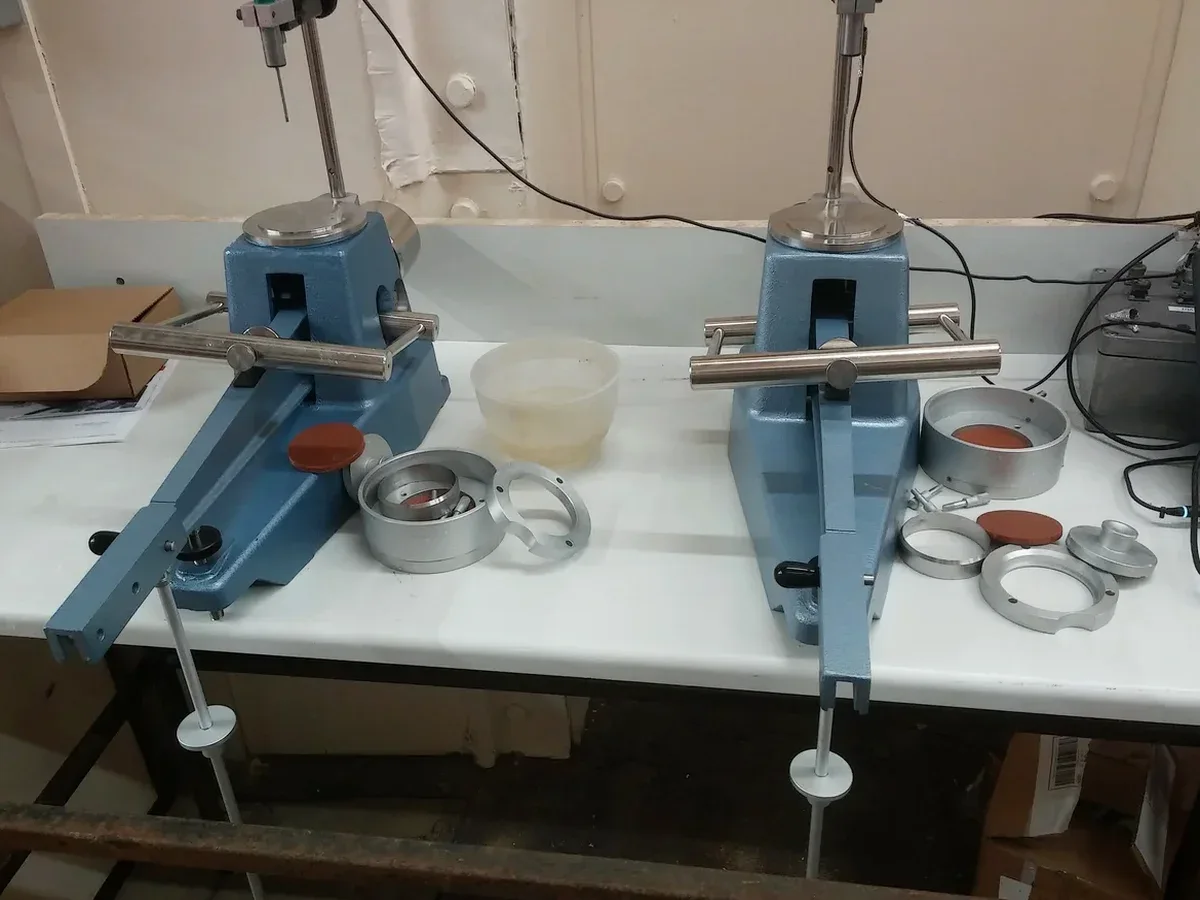
Our Naas laboratory performs Atterberg limits testing as part of a broader suite of classification and mechanical testing solutions that support foundation design, earthworks specification, and pavement evaluation across County Kildare.
Atterberg Limits (LL, PL, PI)
Full determination of liquid limit, plastic limit, and plasticity index on disturbed or undisturbed samples, with results plotted on the Casagrande plasticity chart for USCS classification.
Moisture Content & Liquidity Index
Oven-drying method for natural moisture content determination, combined with Atterberg results to compute the liquidity index and estimate in-situ consistency.
Linear Shrinkage Test
Measurement of the linear shrinkage of a remoulded soil bar, providing a complementary index property that correlates with the clay fraction and plasticity of Kildare tills.
Soil Classification to TII Standards
Classification of earthworks materials according to the Transport Infrastructure Ireland Specification for Road Works, using Atterberg limits alongside particle size distribution data.
Quick answers
What do Atterberg limits actually tell me about a soil in Naas?
Atterberg limits define the moisture contents at which a fine-grained soil changes behavioural state. The liquid limit marks the boundary between liquid and plastic behaviour, while the plastic limit indicates the transition from plastic to semi-solid. The difference between them, the plasticity index, quantifies the range of moisture over which the soil remains plastic. In practical terms for a Naas site, a soil with a PI of 30 will undergo significantly more volume change during wetting and drying cycles than one with a PI of 10, and it will be far more difficult to compact during earthworks. These values also allow the soil to be classified according to the Unified Soil Classification System, which directly informs bearing capacity assumptions and excavation support requirements.
How much does Atterberg limits testing cost for a single sample?
For a single disturbed sample tested in our Naas laboratory, the standard Atterberg limits determination (liquid limit, plastic limit, and plasticity index) typically falls between €60 and €90. The exact cost depends on whether the sample requires wet preparation, whether we are also determining natural moisture content and liquidity index, and the number of specimens needed to meet the repeatability requirements of I.S. EN ISO 17892-12. For multi-sample projects, we supply consolidated pricing that reflects the overall testing programme.
Which soils need Atterberg limits testing under Irish standards?
Any soil where more than 35% of the material passes the 425 μm sieve should be tested for Atterberg limits according to I.S. EN ISO 17892-12 and TII specifications. In Naas, this covers virtually all the glacial till deposits, the alluvial silts along the Grand Canal corridor, and any made ground derived from these materials. Even when the fines content is lower, if the plasticity of the clay fraction is suspected to influence the behaviour of the soil matrix, Atterberg testing provides valuable data. For road construction in accordance with the TII Specification for Road Works Series 600, Atterberg limits are mandatory for all cohesive subgrade and capping materials.
How long does the Atterberg limits test take to complete?
The laboratory procedure itself requires a minimum of 16 hours for the liquid limit portion, because the Casagrande cup specimen must be brought to a moisture content where the groove closes over 13 mm in 25 blows, and this is repeated across at least four points spanning a range of blow counts. The plastic limit determination can be completed concurrently. In total, from sample receipt to a validated report ready for your geotechnical design team, we typically deliver results within two to three working days. For urgent Naas projects, we can prioritise samples and supply preliminary results within 24 hours, with the formal report following the next day.