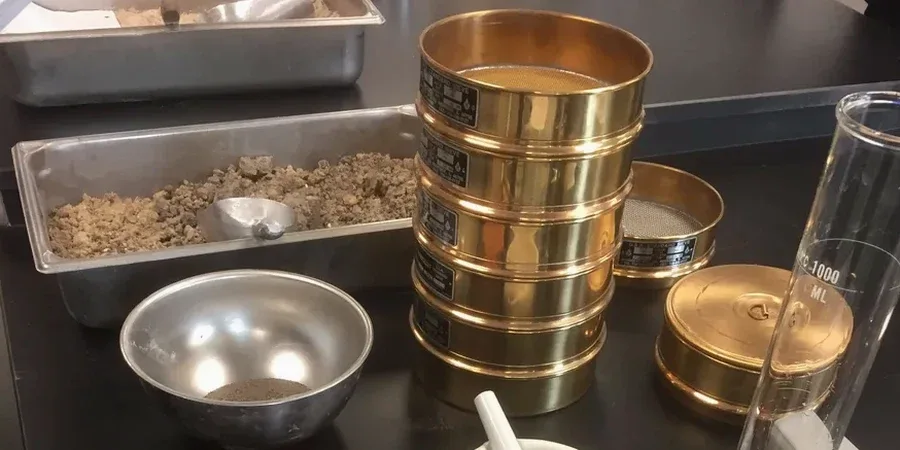
East of the Liffey, the glacial tills around Naas present a testing challenge. The town sits on a mix of limestone-derived gravels and pockets of soft alluvial clay along the Grand Canal branch. These soils can shift from well-graded granular to fine silt within a single site. That variability directly impacts drainage, compaction, and bearing capacity. A test pit investigation often reveals this layering at shallow depth, but you need precise laboratory data to size foundations or specify road materials. The sand cone density test in the field gives you in-place compaction, yet without a grain size distribution you are only guessing at the material's real behaviour under load. Our lab in Naas runs the full I.S. EN ISO 17892-4 procedure, combining mechanical sieving for the coarse fraction with hydrometer sedimentation for fines smaller than 63 microns, so every particle size band is accounted for.
A 2% shift in silt content can move a soil from 'free-draining' to 'moisture-sensitive' and change your entire pavement design.
Service characteristics in Naas
Risks and considerations in Naas
A Naas housing scheme on the Sallins Road ran into trouble when imported granular fill was placed without grading verification. The spec called for a well-graded material; what arrived was a gap-graded aggregate with minimal intermediate sizes. After the first heavy rain, the layer drained unevenly, ponding water against the foundation walls and delaying blockwork by three weeks. Remediation cost six times the price of a grain size analysis. The test also flags expansive fines that can swell when wet, a real risk in the shale-derived clays found near the Wicklow border. Without the hydrometer curve, you are blind to the clay fraction that governs long-term volume change.
Our services
Our Naas laboratory supports site investigation contractors and civil engineering firms across Kildare with the following geotechnical testing solutions:
Combined Sieve & Hydrometer Analysis
The full particle size distribution from coarse gravel to clay fraction, compliant with I.S. EN ISO 17892-4. Includes uniformity and curvature coefficients for classification under I.S. EN ISO 14688.
Pavement Material Grading Verification
Rapid sieve analysis on sub-base and capping layer samples to check compliance with TII grading envelopes before compaction operations begin.
Fines Content Assessment
Focused hydrometer testing when the proportion passing the 63 µm sieve exceeds 5%, determining silt/clay split and identifying potentially reactive minerals.
Quick answers
How much sample do you need for a full grain size analysis?
For soils with maximum particle size up to 20 mm we require around 2 kg of dry material. If gravel cobbles up to 75 mm are present, we need closer to 15–20 kg to ensure the coarse fraction is representative. We can advise on sampling procedure before you dig.
What does the analysis cost for a Naas project?
A standard combined sieve and hydrometer test typically ranges from €90 to €160 per sample, depending on the number of sieve sizes required and whether the hydrometer run needs extended readings for high clay content. Turnaround is normally 3–5 working days.
Can you test samples with high organic content from the canal-side sites?
Yes, but organics require pretreatment. We oven-dry the sample at a controlled temperature, then soak and wet-sieve to remove roots and peat fibres before the hydrometer run. This prevents flocculation and gives a true mineral particle distribution.
How does the grain size result influence my foundation design?
The grading curve tells the design engineer whether the soil is free-draining or water-retaining. Well-graded gravels with low fines content allow high bearing pressures and self-drain. Silty sands and clays demand deeper embedment, possibly a mat foundation design to bridge variable stiffness, and careful management of groundwater during construction.